BY EMMA LAZARUS
Not like the brazen giant of Greek fame,
With conquering limbs astride from land to land;
Here at our sea-washed, sunset gates shall stand
A mighty woman with a torch, whose flame
Is the imprisoned lightning, and her name
Mother of Exiles. From her beacon-hand
Glows world-wide welcome; her mild eyes command
The air-bridged harbor that twin cities frame.
“Keep, ancient lands, your storied pomp!” cries she
With silent lips. “Give me your tired, your poor,
Your huddled masses yearning to breathe free,
The wretched refuse of your teeming shore.
Send these, the homeless, tempest-tost to me,
I lift my lamp beside the golden door!”
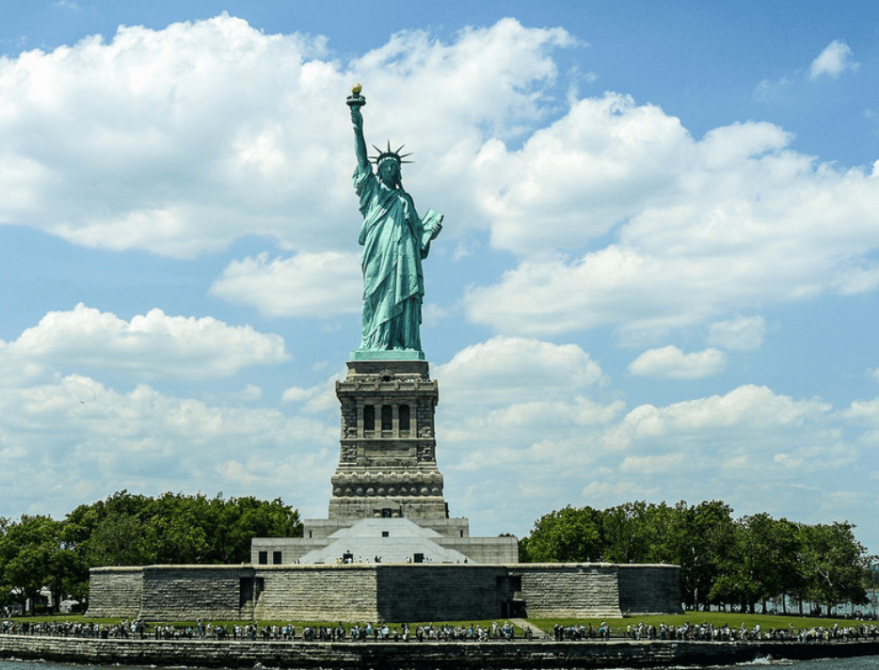
“The New Colossus” is a sonnet written by Emma Lazarus, that was fixed to the side of the Statue of Liberty in 1903. The sonnet was initially written in 1883 to raise money for the construction of a pedestal for the Statue of Liberty. Being a Jewish New Yorker, Lazarus was committed to helping Russian-Jewish refugees and therefore wrote the poem as a “guide” for those looking for freedom. Mounting this sonnet to the pedestal gave the statue a whole new purpose. It turned Liberty into a symbol of hope for outcasts. Words in the poem about embracing the “huddled masses yearning to breathe free” especially gave hope to immigrants and refugees fleeing their home countries.
It wasn’t until the 1920s that the influence the sonnet provided started to fade. During this period of time, the Immigration Act of 1924 was passed, which restricted the number of immigrants allowed to enter the United States at one time. In addition to greatly reducing the number of immigrants allowed to enter the country, the quota restricted Asian immigrants from entering the country altogether. By the end of the 1930s, at the time when the Great Depression concluded, the number of immigrants in the United States had greatly decreased. Many immigrants were forced out of the country during this time as a result of the large unemployment rates. In the years following the Great Depression, more restrictions were placed on immigration rates through quotas like the Displaced Persons Act of 1948 and the McCarran-Walter Act of 1952. Between 1920 and 1970, the percentage of immigrants in the U.S. dropped from 13.2% to 4.7%.
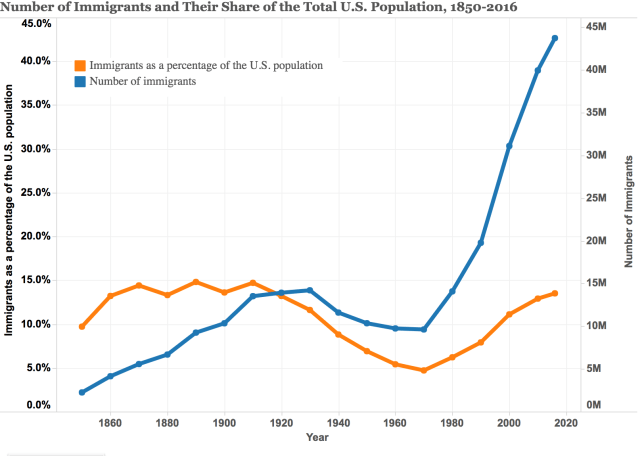
As seen in the table above, immigration began to increase again with the Immigration and Naturalization Act of 1965. This law abolished the previous immigration quotas. Although the issue with immigration seemed to be fixed, problems focused strictly on refugees entering the country began to arise. With these arising problems, people began questioning whether or not the New Colossus should remain mounted to the Statue of Liberty. People began criticizing the fact that laws placed on refugees went against what the poem was trying to convey. The poem expresses that the “Mother of Exiles. From her beacon-hand glows world-wide welcome”, yet there are seven countries on Donald Trump’s refugee ban. The seven countries on this list include Iran, Libya, Somalia, Syria, Venezuela, North Korea, and Yemen. Can you really say that the United States welcomes people worldwide when people searching for refuge from these countries are abandoned? It’s ironic that these countries are on the banned list when the people there are in the most need of refuge. These asylum seekers are unwelcome in the U.S. for things beyond their control.
Iran
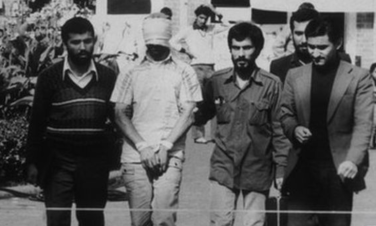
Resulting from the past three decades of war in Iran, there is an approximate number of 980,000 refugees seeking sanctuary. The people of Iran are constantly threatened by terrorism, disease, and hunger. Children and women are raped on a daily basis, houses are invaded and destroyed regularly, and the lack of clean water makes sanitation almost impossible.
Libya
There are over 1.1 million migrants and refugees in Libya that are in need of help and refuge. Refugees are constantly risking their lives when they flee by boat to other countries. If the United States wanted to abide by what the New Colossus states, life-saving assistance would be provided and we would help these “homeless, tempest-tost” people in need.
Somalia
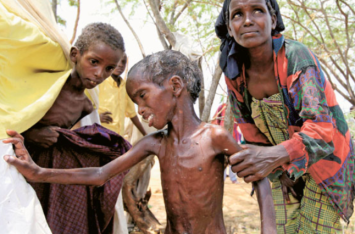
There are over 1 million refugees from Somalia and there are approximately 2.1 million internally displaced people. Since the United States won’t take refugees from this country, those in need flee to countries like Kenya, Ethiopia, and Yemen. Even though these people are fleeing the famine, drought, civil war, and disease of their home country, the places they are fleeing to can’t provide the opportunities the U.S. could.
Syria
War and devastation in Syria have created the largest refugee crisis ever. Over 5.6 million people have fled the country as refugees and over half of the people affected by this displacement is children. Life is a struggle even for those who flee to a refugee camp, as they have very limited financial resources. Following the words of the New Colossus and not abandoning the hope it gives these “outcasts” could help save many innocent lives.
The other countries on the abandoned list and even those not on it, face similar problems to that of Iran, Libya, Somalia, and Syria. The purpose of adding the New Colossus to the Statue of Liberty was to give hope to those in these horrible circumstances. Refugees and immigrants should be able to look towards the United States as a place of refuge and a place for a fresh start like the poem expresses. What’s the point of keeping the New Colossus mounted to the side of the Statue of Liberty if it’s going to give people false hope? Unless the United States makes a better effort to help refugees and others in need, the poem should be taken down. It’s wrong to “advertise” something as important as freedom if we’re not going to follow through with our “advertisement.”
What do you think? Should the New Colossus stay or should it go? This is a question that really needs to be considered, especially in today’s society.
Works Cited
Alchin, Linda. “Linda Alchin.” 1600’s, 1700’s, 1800’s and 1900’s ***, Siteseen Limited, 1 Jan. 2018, www.emmigration.info/us-immigration-trends-1900-1940.htm.
Ha, Thu-Huong. “The Story behind the Statue of Liberty’s Unexpected Transformation into a Beacon for Refugees.” Quartz, Quartz, 1 Feb. 2017,
Hunter, Walt. “The Story Behind the Poem on the Statue of Liberty.” The Atlantic, Atlantic Media Company, 17 Jan. 2018,
U.S. Department of State, U.S. Department of State,
history.state.gov/milestones/1921-1936/immigration-act.
“Welcoming Refugees: How the Statue of Liberty Became the ‘Mother of Exiles’ – Congregation Beth El of Montgomery County.” Congregation Beth El of Montgomery County, 9 Feb. 2016,

